


Unsupervised Coordinate Projection Network for Sparse-View Computed Tomography
Sparse-view Computed Tomography (SVCT) has great potential for decreasing patient radiation exposure dose during scanning. We propose SCOPE, a self-supervised coordinate projection network, for artifact-free CT image reconstruction from sparse-view sinograms. By leveraging an implicit neural representation network and a novel re-projection strategy, we improve the solution space and stability of the inverse problem. The CT image is represented as an implicit function of spatial coordinates, and a dense-view sinogram is generated. Filtered Back Projection is then applied for final reconstruction. Our SCOPE model, integrated with hash encoding, achieves state-of-the-art results in sparse-view CT image reconstruction, surpassing recent INR-based and supervised DL methods.
[1] Qing Wu, Ruimin Feng, Hongjiang Wei, Jingyi Yu, Yuyao Zhang, Self-Supervised Coordinate Projection Network for Sparse-View Computed Tomography, IEEE TCI, 2023
[2] Qing Wu, Xin Li, Hongjiang Wei, Jingyi Yu, Yuyao Zhang§: “Joint Rigid Motion Correction and Sparse-View CT via Self-Calibrating Neural Field,” ISBI, 2023 Apr.
[3] Ruimin Feng, Qing Wu, Yuyao Zhang, Hongjiang Wei§: “IMJENSE: Scan-specific IMplicit representation for Joint coil sENSitivity and image Estimation in parallel MRI,” IEEE TMI, Revised 2023, Apr.

Robust self-supervised 3D isotropic fetal brain MRI reconstruction.
We propose a robust self-supervised volume reconstruction technique for fetal MR images, addressing slice misalignment and motion artifacts. Our approach involves two learning modules: one for high-fidelity 3D volume reconstruction and another for 2D slice misalignment correction. The volume reconstruction module utilizes a comprehensive forward model and an under-parameterized deep decoder to eliminate artifacts caused by misalignment and motion. Additionally, the misalignment correction module employs iterative slice-to-volume registration. Our self-supervised DL methodology achieves state-of-the-art performance in 3D fetal brain reconstruction without relying on ground truth references.
[4] Jiangjie Wu, Zhenghao Li, Lihui Wag, Hongjiang Wei, Yuyao Zhang§: ASSURED: A Self-Supervised Deep Decoder Network for Fetus Brain MRI Reconstruction, ISBI, 2023 Apr.
[5] Jiangjie Wu, Zhenghao Li, Lihui Wang, Hongjiang Wei, Yuyao Zhang§: ASSURED: A Self-Supervised Deep Decoder Network for Fetus Brain MRI Reconstruction, Neuroimage, Submitted: 2022 May. (Top Journal, IF 7.4)
[6] Jiangjie Wu, Zhenghao Li, Qing Wu, Yutong Wang, Ling Jiang, Zhaoxia Qian, Hongjiang Wei, Yuyao Zhang§: Longitudinal Chinese Population Structural Fetal Brain Atlases Construction toward precise fetal brain segmentation, EMBC, 2021.

An Arbitrary Scale Super-Resolution Approach for 3D MR Images
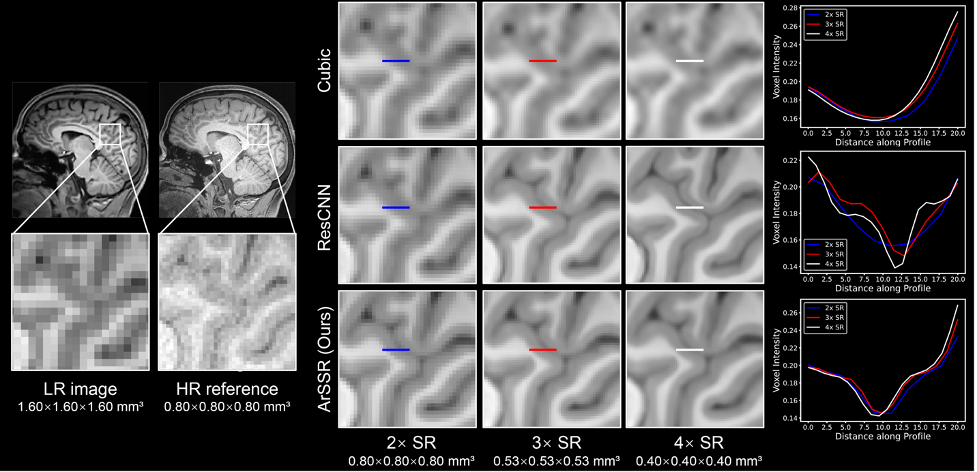
We introduce ArSSR, an Arbitrary Scale Super-Resolution approach for recovering 3D high-resolution (HR) MR images. The ArSSR model employs a shared implicit neural voxel function to represent both the low-resolution (LR) and HR images, allowing for arbitrary up-sampling rates. By training the model on paired HR and LR examples, the implicit voxel function is approximated using deep neural networks. The ArSSR model comprises an encoder network for feature extraction and a decoder network to approximate the implicit voxel function. Experimental results demonstrate that the ArSSR model achieves state-of-the-art performance in 3D HR MR image reconstruction, with the ability to handle arbitrary up-sampling scales using a single trained model.
[7] Qing Wu, Yuwei Li, Lan Xu, Ruimin Feng, Hongjiang Wei, Qing Yang, Boliang Yu, Xiaozhao Liu, Yingyi Yu§, Yuyao Zhang§: IREM: High-Resolution Magnetic Resonance (M.R.) Image Reconstruction via Implicit Neural Representation, MICCAI, 2021.
[8] Qing Wu, Yuwei Li, Yawen Sun, Yan Zhou, Hongjiang Wei, Jingyi Yu, Yuyao Zhang§: An Arbitrary Scale Super-Resolution Approach for 3-Dimensional Magnetic Resonance Image using Implicit Neural Representation, IEEE JBHI. vol. 27, no. 2, pp. 1004-1015, Feb. 2023, doi: 10.1109/JBHI.2022.3223106. (Top Journal, IF 7.021)
[9] Chaolin Rao*, Qing Wu*, Pingqiang Zhou, Jingyi Yu, Yuyao Zhang§, Xin Lou§: An Energy-efficient Accelerator for Medical ImageReconstruction from Implicit Neural Representation, IEEE Transaction on Circuits and Systems I, Regular Papers, Early access: DOI: 10.1109/TCSI.2022.3231863. (Top Journal, IF 3.833)
[10] Haonan Zhang*, Yuhan Zhang*, Qing Wu, JIangjie Wu, Zhiming Zhen, Feng Shi, Jianmin Yuan, Chen Liu, Yuyao Zhang§: “Self-supervised arbitrary scale super-resolution framework for anisotropic MRI,” ISBI, 2023
[11] Jun Li*, Xiaojun Guan*, Qing Wu, Chenyu He, Weiming Zhang, Chunlei Liu, Hongjiang Wei, Xiaojun Xu§, Yuyao Zhang§: Direct Localization and Delineation of Human Pedunculopontine Nucleus based on a Self-supervised Magnetic Resonance Image Super-resolution Method, Human Brain Mapping. Accepted: 2023 Mar. (Top Journal, IF 5.04)
Temporal consistent longitudinal brain atlas construction using Implicit Neural Representation
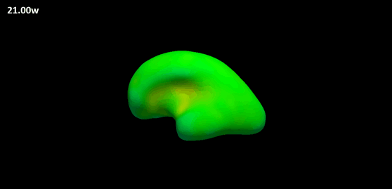
We propose a deep-learning framework to improve longitudinal brain atlases. By treating the issue as a 4D image denoising task, our framework generates a continuous and noise-free atlas using implicit neural representation. This approach addresses temporal inconsistency caused by averaging discrete time points independently and differences in onto-genetic trends. Evaluation on two types of brain atlases demonstrates enhanced temporal consistency and accurate representation of brain structures. Additionally, our method enables the creation of higher-resolution 4D atlases.
[12] Jiangjie Wu, Taotao Sun, Boliang Yu, Zhenghao Li, Qing Wu, Yutong Wang, Zhaoxia Qian, Yuyao Zhang, Ling Jiang, Hongjiang Wei, Age-specific structural fetal brain atlases construction and cortical development quantification for chinese population, NeuroImage, 2021
[13] Lixuan Chen, Jiangjie Wu, Qing Wu, Hongjiang Wei, Yuyao Zhang, Continuous longitudinal fetus brain atlas construction via implicit neural representation, MICCAI workshop PIPPI 2022, 2022
[14] Lixuan Chen, Jiangjie Wu, Qing Wu, Guoyan Lao, Hongjiang Wei, Yuyao Zhang, COLLATOR: Consistent Spatial-Temporal Longitudinal Atlas Construction via Implicit Neural Representation, IEEE TMI, Submitted
Zero-shot Learning for Image Denoising
We proposes a self-supervised image denoising method called Noise2SR (N2SR) to address the limitations of existing methods in real scene noise removal. N2SR trains a simple and effective denoising model using paired noisy images of different dimensions. This training strategy enables efficient self-supervision and restoration of more image details from a single noisy observation. Experimental results demonstrate that N2SR outperforms other self-supervised deep learning denoising methods in simulated and microscopy noise removal. N2SR holds promise for enhancing the quality of various scientific imaging applications.
[16] Xuanyu Tian, Qing Wu, Hongjiang Wei, Yuyao Zhang§: Noise2SR: Learning to Denoise from Super-Resolved Single Noisy Fluorescence Image, MICCAI, 2022 Oct.
[17] Changhao Jiang1*, Xuanyu Tian 1*, Yanbin Li, Jiangjie Wu, Xin Mu, Lei Zhang, Yuyao Zhang§: “Self-Supervised High-dimentional Megnatic Resonance Image Denoising using Super-Resolved Single Noisy Image,” ISBI, 2023 Apr.


 沪公网安备 31011502006855号